


The Moon
The Moon has fascinated humanity for thousands of years. It has shaped calendars, inspired myths and art, and guided scientific discovery.
Today, the Moon is once again becoming a central destination for human exploration. Scientists, engineers, governments, companies, and international organizations are working together to expand humanity’s presence beyond Earth.
Exploring the Moon is not only about science and technology. It is about international cooperation, discovery, and preparing for humanity’s future in space.
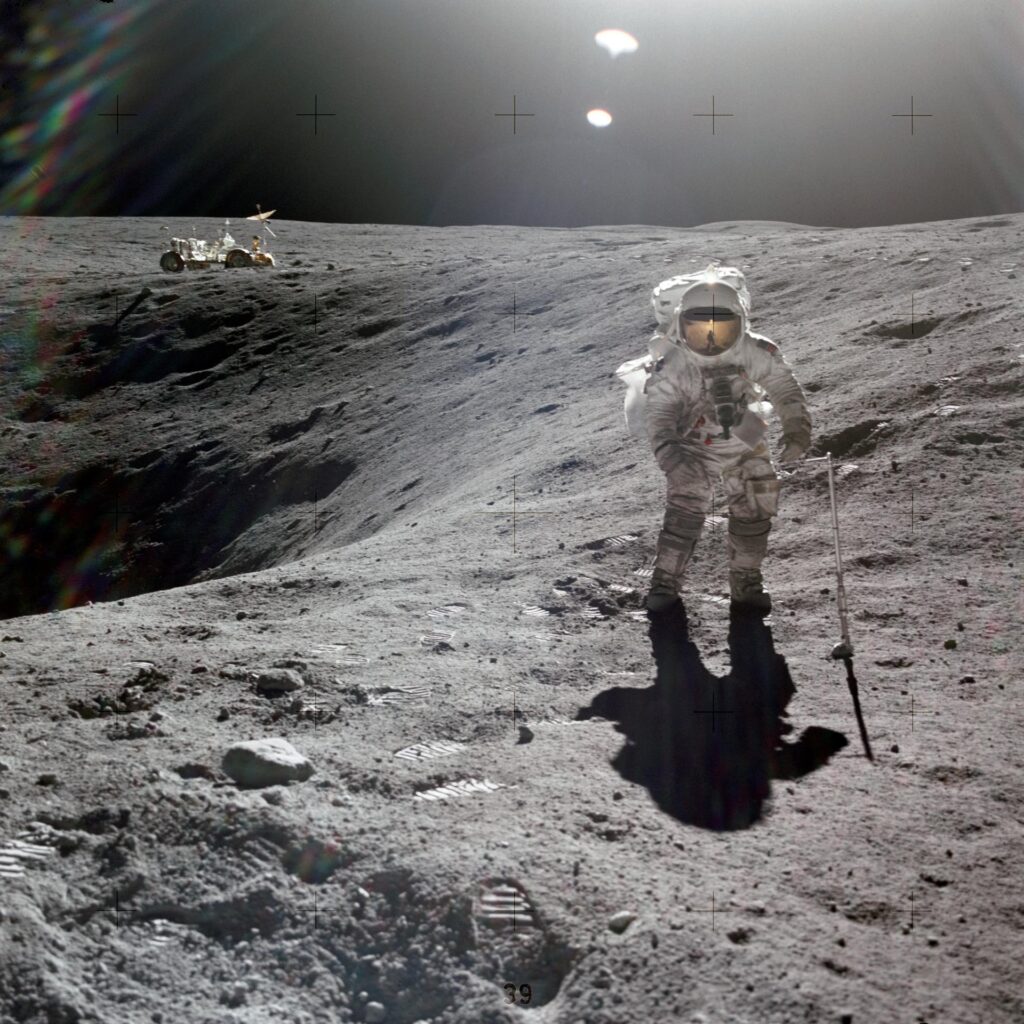
Humans on the Moon
Humanity first reached the Moon in July 1969 with the Apollo 11 mission, when Neil Armstrong and Buzz Aldrin walked on the lunar surface.
Over the course of the Apollo program, twelve astronauts explored the Moon, conducted scientific experiments, and brought back samples that transformed our understanding of lunar geology and the early history of the Solar System.
The last human mission to the Moon was Apollo 17 in December 1972.
Although humans have not returned to the Moon since then, robotic missions from many countries have continued to study it, revealing new discoveries about its composition, history, and potential resources.
Why Are We Going Back to the Moon?
After more than fifty years, the Moon is once again becoming a destination for exploration. Several important developments have renewed global interest in lunar missions.
Scientific Discovery
New robotic missions have revealed that the Moon contains water ice, particularly in permanently shadowed craters near the poles. This discovery could support future exploration by providing water, oxygen, and potentially fuel for spacecraft. Studying the Moon also helps scientists better understand the formation of Earth and the early Solar System.
Technology and Innovation
Advances in robotics, spacecraft technology, and commercial space capabilities have made lunar missions more accessible. Private companies are increasingly involved in developing landers, spacecraft, and infrastructure that can support future missions.
International Cooperation
Today, lunar exploration is no longer driven by geopolitical competition alone. Instead, it is becoming a global effort involving many countries and organizations.
New programs, including the Artemis Program and other international initiatives, aim to return humans to the Moon and establish a sustainable presence there.
Many nations are contributing scientific instruments, technology, and expertise to future lunar missions.
The Moon as a Gateway to the Future
The Moon is the closest celestial body to Earth, located about 384,000 km away. A spacecraft can reach it in just a few days. Because of its proximity, the Moon offers an ideal place to test technologies and systems needed for deeper space exploration. Future lunar missions may include:
- long-duration human habitats
- robotic and human scientific research stations
- new energy and resource technologies
- preparation for human missions to Mars
These activities may eventually lead to the development of a sustainable human presence on the Moon.
One vision for this future is the concept of a Moon Village, an open and international framework where many actors contribute to exploration, science, and economic activity on the lunar surface. The Moon Village Association , a non-governmental organization, founded in 2017 in Vienna, aims to promote international collaboration in the exploration and settlement of the Moon through fostering cooperation between government space agencies, commercial space entities, and academia to advance humanity’s presence on the Moon.
A Shared Journey
Human exploration of the Moon represents one of the most ambitious endeavors in history. As more nations and organizations participate in lunar missions, the Moon is becoming a place where science, innovation, and international collaboration come together. Returning to the Moon is not just about revisiting a historic achievement. It is about building a future in which humanity works together to explore, discover, and expand beyond Earth.