- This event has passed.
Protecting Lunar Heritage: Developing Guidelines and Recommendations for Controlled Lunar Deorbiting
September 14 @ 14:00 – 16:00
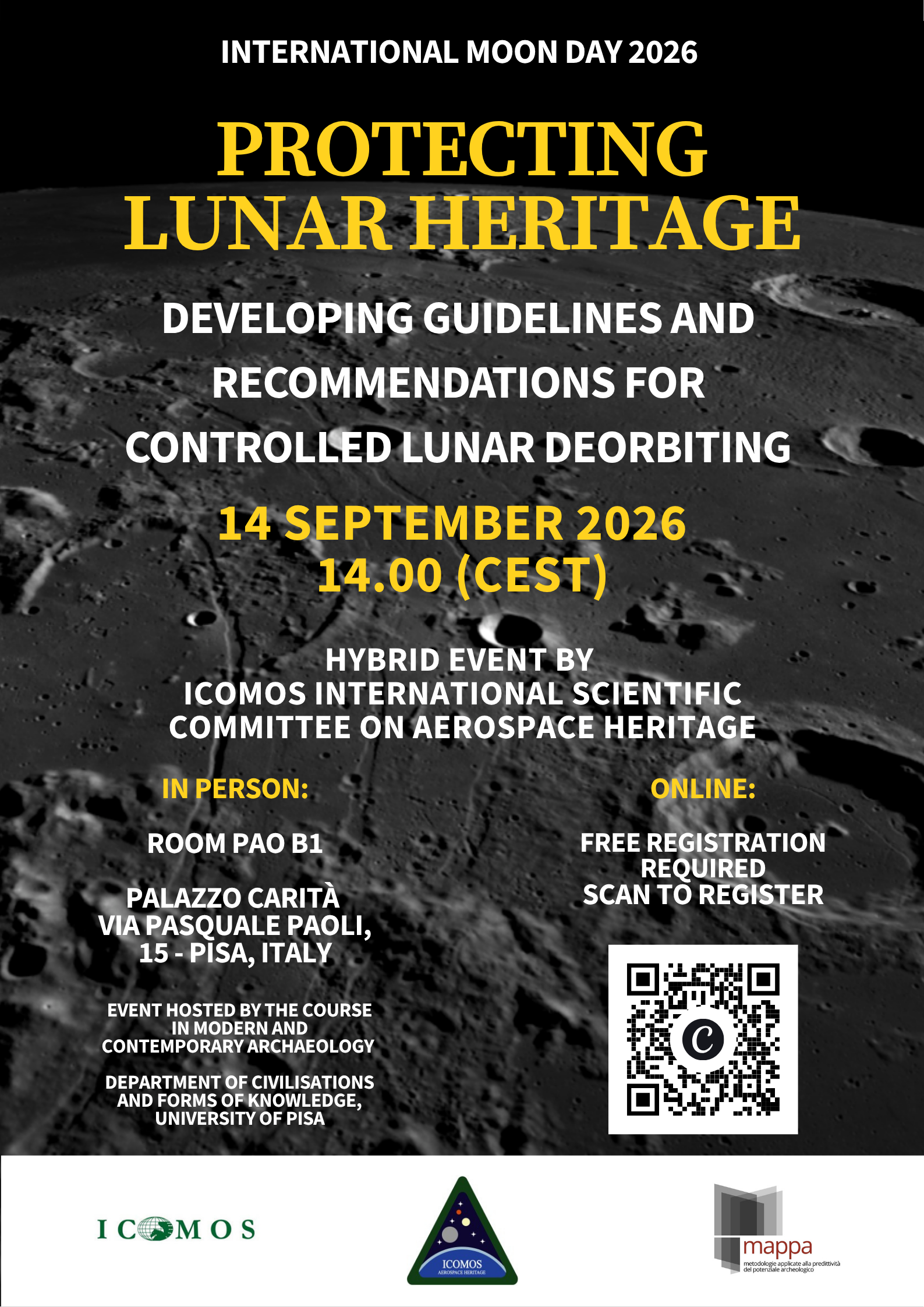
On the occasion of the 67th anniversary of the impact of the Soviet probe Luna 2, the first artificial object to reach the Moon, the ICOMOS International Scientific Committee on Aerospace Heritage proposes an event dedicated to the protection of lunar archaeological heritage, with particular attention to the risks posed by the impacts of de-orbited satellites and rocket stages.
The Moon preserves the material remains of dozens of space missions conducted since 1959, documenting humanity’s earliest interactions with another celestial body. Although the lunar environment has favoured their preservation, these sites are becoming increasingly vulnerable due to natural weathering processes and the growing number of exploration and commercial activities.
As lunar traffic increases, controlled crash landings of orbiters and rocket stages are becoming an increasingly attractive and potentially sustainable end-of-mission disposal strategy. However, the degree to which such impacts can be effectively controlled remains uncertain, as controlled lunar impacts have not yet been established as a sustained and consistently reliable practice. Moreover, high-velocity regolith ejecta generated by these impacts may damage or contaminate lunar areas requiring particular protection. These include historical heritage sites associated with past lunar exploration and natural areas of special scientific or logistic significance, including the polar regions (>75°N/S), which contain water-ice deposits of strategic importance; the equatorial zone, which hosts a major concentration of near-side heritage and may support future launch infrastructure; the lunar maria, which are of interest for both in-situ resource utilisation and radio-quiet astronomy; the South Pole–Aitken Basin, which is of particular scientific interest for understanding the stratigraphy of the deep mantle and contains the Chang’e 4 and Chang’e 6 sites of historical activity; and other scientifically significant formations, such as lobate scarps, lunar pits, magnetic anomalies, and Copernican-age craters. Impact ejecta may also threaten existing operational infrastructure, including, for example, the Lunar Laser Ranging Retroreflectors.
To address these challenges, the ICOMOS International Scientific Committee on Aerospace Heritage, which is actively engaged in the study and protection of aerospace heritage, is drafting guidelines and recommendations for controlled lunar crash landings. These are intended to provide expert technical advice to inform consensus-based decision-making within COPUOS and to support the future development of international standards and policies.
The event will introduce the Committee and its activities, provide an overview of lunar heritage, the threats to its preservation and the current legal framework, and conclude with a presentation of the Committee’s ongoing work, including preliminary recommendations for the safe management of controlled lunar crash landings.